
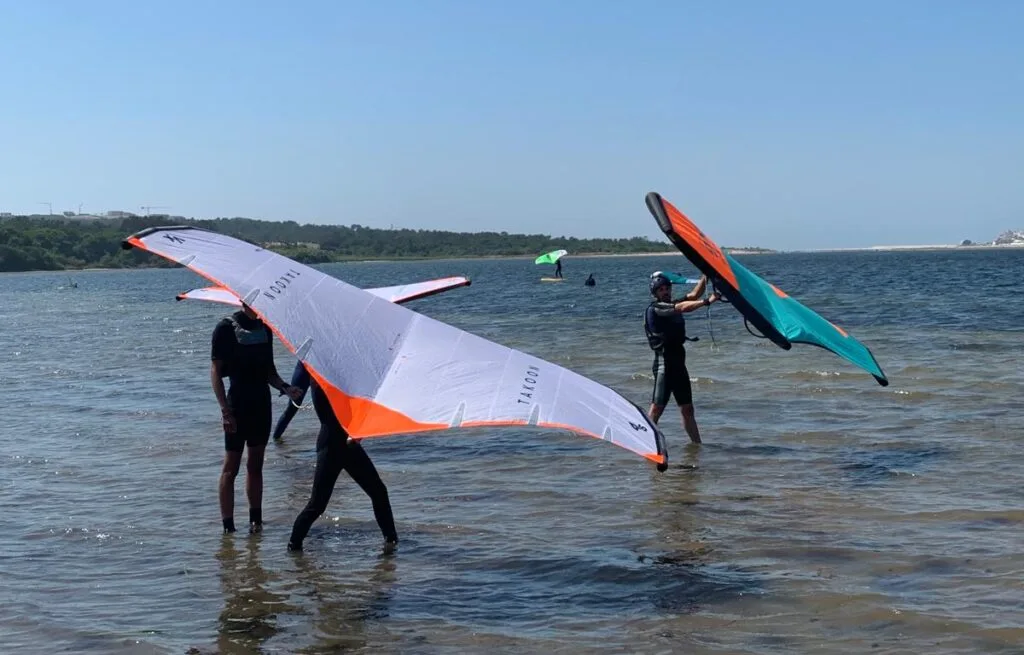
If you’ve spent any time near the lagoon in the last few years, you’ve seen them.
Riders standing on a small board, holding an inflatable wing in their hands, gliding silently above the water on a foil. They look weightless. They make it look easy.
It isn’t easy. But it’s a lot easier than it looks, and for most people it’s easier than learning to kitesurf. This article is for the person who has stood on the sand at Lagoa de Óbidos and wondered “could I do that?”. Here’s everything you need to know before your first wing foil lesson.
What wing foil actually is
Wing foil is the newest sport in a family that includes windsurfing, kitesurfing and surfing. You stand on a board with a hydrofoil underneath it, and you hold an inflatable wing that catches the wind and powers you forward.
The foil is the magic part. Once you have enough speed, it generates lift and the board rises out of the water. You’re flying above the surface, silently, on a mast. Nothing else on the water feels like it.
The wing replaces the kite or the sail. It isn’t attached to lines. You hold it. If you let go, it drifts downwind and floats, and you swim to your board.
- No lines, no harness, no long setup. Pump the wing, grab the board, walk in.
- A wide wind range. Wing foil works in lighter wind than kitesurfing, so you get more sessions per week.
- A gentle learning curve. Most students get their first flights on the foil within a few sessions.
Why Lagoa de Óbidos is such a good place to learn
Learning wing foil in waves or chop is hard for a simple reason: the foil under your board is unstable, and every bump tries to throw you off. Flat water changes everything.
The water is flat. Inside the lagoon there are no waves and no swell. Your first sessions are about balance, and flat water gives you a fair chance.
There are shallow areas. When you fall, and you’ll fall a lot on day one, you often just stand up, reset and go again instead of swimming.
The wind is predictable. In season, the Nortada, the north-westerly thermal wind, builds in the afternoon. Inside the lagoon it’s even a little stronger than at the top of the lagoon thanks to a venturi effect, which is exactly what a foil likes.
The bottom is sand. No rocks, no reef. Your foil (and your feet) will thank you. We do advise water shoes, because there are shells and seaweed in places.
The lagoon spot is open all year and works for the foil. Read more on our wing foil spot page.
How a wing foil lesson works at Passaro
Every lesson is private (one instructor, one student) or duo (one instructor, two students maximum). No big groups. Here’s the shape of the first sessions.
Session 1: the wing, then the board
You start on the sand, learning to hold the wing, position it in the wind, and neutralise it so it stops pulling. It takes most people under an hour to feel in control. Then you go in the water on a big, stable board without a foil: balance, wing position, riding across the lagoon. By the end of the first session most students are moving under their own power.
Session 2: first lift
You switch to a real wing foil setup. The instructor keeps it forgiving so that when you go too high, you splash rather than crash. This session is about feeling the foil lift you for the first time. It lasts a second, the board rises, then drops. That moment is why people get hooked.
Session 3: holding the flight
For most people this is when it clicks. Sustained rides on the foil: a few seconds, then ten, then longer. From here you work on flying in both directions, riding upwind so you can go where you want, and your first turns.
Everyone’s curve is different, but the honest rule is: don’t judge the sport on one session. Book at least a few hours and give the foil a chance to click.
Formats and prices
Lessons are booked by the hour, from a single two-hour session to try the sport up to twelve hours over five days to leave riding on the foil. Duo lessons are the same format for two people who book together, at a lower price per person.
At the time of writing, a two-hour private wing foil lesson is €130 and a two-hour duo lesson is €100 per person, with multi-day packs bringing the hourly price down. Current prices, packs and online booking are on the wing foil lessons page.
Every lesson includes:
- North wing foil equipment: wing, foil and board matched to your weight and level
- Wetsuit, helmet and impact vest
- A certified instructor, one-to-one in privates and one-to-two in duos
Wing foil rental is available too, once you’re autonomous on the foil. Details are on the same page.
What to bring
We provide all the gear, plus wetsuit, helmet and vest. You bring a swimsuit, sunscreen (the lagoon is very reflective), sunglasses with a strap if you wear them, water shoes if you have them, and dry clothes for after.
Don’t buy anything before your first lessons. Wait until you know you love it, then ask us what actually makes sense for your level.
Who can learn
Almost anyone, with two practical conditions. You need to be a comfortable swimmer, because you’ll be falling in water that’s sometimes over your head. And you need reasonable general fitness: the first sessions work your shoulders, back and core more than you expect.
Any board sport helps (surf, snowboard, paddleboard, kitesurf), and so does sailing or windsurfing, because you already understand wind angles. What hurts is trying to muscle it. Wing foil is about angles and balance, not strength.
When to come
The best period at the lagoon is April to November: more windy days and warmer water. Summer is peak season with the most reliable thermal wind, so book ahead. Late spring and September are quieter with great wind. A 4/3 wetsuit is the norm here most of the year.
How to book
Book online on the wing foil lessons page, or use the booking form if you have questions about your level, dates or which pack to choose. We’re a small school and you’ll be talking to the people who’ll actually teach you.
See also: kitesurf lessons · the wing foil spot · FAQ · where to stay